


In embedded systems, robotics, and autonomous platforms, control logic must satisfy a strict set of requirements: determinism, predictability, testability, real-time behavior, and maintainability at scale.
Classical Finite State Machines (FSMs) have long been used to model this logic. But as systems grow in complexity, the classical FSM model breaks down — and when it does, it breaks hard. This post explains what UMTSM is, why it was needed, and how it redefines the role of state machines in modern reactive systems.
The Problem with Classical FSMs
There is a common misconception worth addressing upfront:
"State machines model behavior."
They do — but only partially. And that partial coverage creates real problems at scale.
State-First Thinking Leads to State Explosion
Most FSMs are designed by starting with states — Idle, Running, Error, Recovery — then adding behavior inside them. Over time, states become overloaded, transitions become tangled, and logic spreads uncontrollably. The result:
- High cyclomatic complexity
- Difficult testing and verification
- Fragile, brittle systems
No Structured Data Awareness
Traditional FSMs operate on event → transition logic. But real-world systems depend heavily on data conditions:
if temperature > 30 AND battery < 20 → act
Without structured data integration, FSMs hide logic inside state handlers, rely on implicit conditions, and become increasingly opaque over time.
Undefined Execution Semantics
Perhaps the most dangerous problem: in many FSM implementations, questions like "when are guards evaluated?", "what happens if multiple transitions match?", or "what is the execution order?" have implicit answers — or no answers at all. This leads to nondeterminism, inconsistent behavior, and systems that are genuinely hard to debug.
What is UMTSM?
UMTSM (Unified Modeling Technologies State Machine) is defined as:
A deterministic, event-driven, hierarchical extended state machine platform with explicit execution semantics and code generation capabilities.
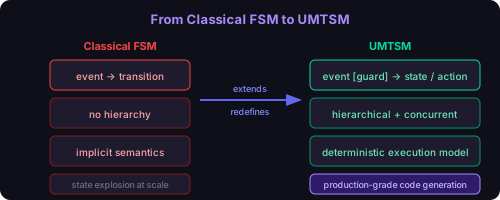
It is not just a state machine framework. It extends classical FSMs with hierarchical modeling (UML Statecharts), data-aware guards, an explicit and formal execution model, a strong type system, deterministic transition resolution, and production-grade code generation.
The FSM evolution from classical to UMTSM looks like this:
Core Design Principles
1. Event-Driven, Not Data-Polling
UMTSM strictly follows:
Event → Evaluation → Transition
Rather than polling state in a loop, data is processed outside the state machine. Event generators — which can themselves be state machines — produce meaningful, semantically rich events:
temperature_crossed_threshold
battery_low
gps_lost
This decoupling results in lower CPU usage, better separation of concerns, and a clearer system architecture.
2. Deterministic Execution Model
UMTSM defines a formal, six-step execution cycle:
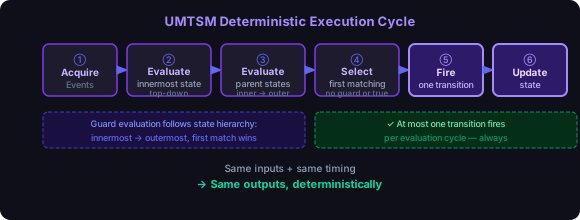
- Acquire events
- Evaluate guards in the innermost current state, top-down
- Evaluate guards in parent states, inner to outer
- Select the first transition whose guard is absent or evaluates to true
- Fire exactly one transition
- Update state
The key guarantee: given the same inputs and timing, the system produces the same outputs. Always.
3. Hierarchical and Concurrent Modeling
UMTSM fully supports UML Statechart semantics:
- Nested and composite states
- Orthogonal regions (true parallel execution)
- Fork/Join synchronization
- Deep and shallow history
- Entry/Exit points
- Final and terminate states
This allows modeling of complex workflows, concurrent subsystems, and layered control logic that would otherwise require dozens of flat states.
4. Guard-Based Decision Making
Transitions in UMTSM follow a complete, expressive syntax:
event_a, event_b [temperature > 30 && is_daytime] -> monitoring / open_windows(), start_ventilation();
Guards are pure expressions, operate on shared data, and are evaluated deterministically. No hidden side effects, no implicit ordering.
5. Controlled Execution with do and complete
UMTSM introduces a powerful pattern for self-evaluating states:
state check_temperature
{
    do / evaluate_temperature;
    [is_high] --> check_temperature / start_cooling();
    [is_low]  --> check_temperature / start_heating();
}
The do action runs, emits an implicit complete event, guards are evaluated, and the state may re-enter itself. This creates a controlled execution loop without uncontrolled polling — a critical distinction for real-time systems.
Architecture Overview
A typical UMTSM-based system follows a clean layered architecture:
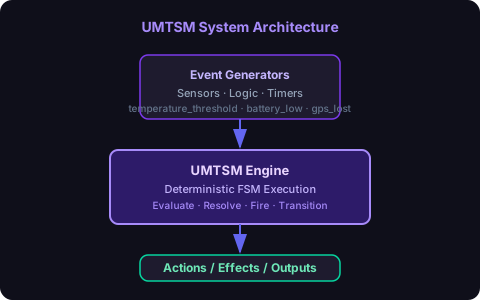
The separation is explicit:
| Concern | Location |
|---|---|
| Data processing | Event generators |
| Control logic | State machine |
| Execution model | UMTSM engine |
| Effects | Actions / outputs |
Strong Type System and Code Generation
UMTSM integrates tightly with C/C++, supporting built-in primitive types, structs, unions, enums, external types, namespaces, and global/shared data. This enables:
- Seamless, type-safe code generation
- Direct integration with existing codebases
- No runtime type erasure or hidden casting
Determinism and Conflict Resolution
UMTSM enforces a strict rule:
At most one transition may fire per evaluation cycle.
Conflict resolution strategies are explicit and configurable:
- Strict — compile-time error if ambiguity exists
- Priority-based — explicit numeric priority per transition
- First-match — ordered evaluation, first passing guard wins
This eliminates the class of bugs that arise from nondeterministic FSM implementations.
Comparison with Other Approaches
| Feature | Classical FSM | UML Statecharts | UMTSM |
|---|---|---|---|
| Hierarchy | ✗ | ✓ | ✓ |
| Data-aware guards | ✗ | ✓ | ✓ |
| Formal execution semantics | ✗ | Partial | ✓ |
| Determinism guarantee | ✗ | Partial | ✓ |
| Conflict resolution policy | Implicit | Undefined | Explicit |
| Production code generation | Limited | Limited | ✓ |
| Real-time suitability | ✓ | Partial | ✓ |
| Event-driven model | ✓ | ✓ | ✓ |
The Key Insight
UMTSM makes a fundamental architectural shift that is easy to state but hard to internalize:
State machines are not responsible for tracking all data.
Instead, data changes generate events, and events drive the state machine. This prevents the single most common failure mode in FSM-based systems: overloading the state machine with data awareness it was never designed to handle, creating implicit dependencies and hidden coupling that are nearly impossible to test.
Future Directions
UMTSM is evolving toward a unified reactive platform. Planned features include:
- Expression engine — eliminating function-based guards in favor of inline expressions
- Parameterized events — events carrying typed payloads directly into guard expressions
- Data-flow modeling — integrating reactive data pipelines with event generation
- Compile-time analysis — static verification of reachability, deadlock freedom, and guard coverage
- Reactive pipeline integration — bridging UMTSM with stream-based architectures
Conclusion
UMTSM does not replace state machines. It redefines their role — from static behavioral diagrams to deterministic execution systems that bridge modeling, implementation, and real-time deployment.
The guiding principle is simple:
Your state machine should not try to understand the entire world. It should react to meaningful events — deterministically.
UMTSM is built exactly for that.


